VPlay: All in One Video Player
- 3.6
- Rating
- 5.00M
- Installs
- Free
- Price

 Analysis by App-foxy
I spent time with VPlay: All in One Video Player as a mobile video app, paying particular attention to how comfortably it works for different people and in different everyday situations. Its main appeal is straightforward: it is built to play video in many formats while also handling music and high-definition media. That makes it more ambitious than a basic gallery player, although the experience is not equally polished for every user or every kind of content.
Developed by XEN Studios, the app sits in the video players and editors category and is available free of charge. It is rated for Everyone, which makes it an easy option to consider for a shared family phone or a personal device used by people with different levels of technical confidence. The app has been available since Oct 22, 2017, and its current version is 2.58, with Android 7.0 or later required.
My overall impression is that VPlay makes the most sense when I want one uncomplicated place for locally stored videos and music. It is less convincing as a complete replacement for a streaming service, a specialist accessibility tool, or a highly controlled media library. The useful question is not simply whether it plays video, but whether its controls, visual presentation, and format-focused approach suit the way you actually watch.
You May Also Like

 Blood Strike: 2.5 Anniversary
Blood Strike’s Loadouts Turn Every Drop Into a Tactical Gamble
A close look at Blood Strike’s custom loadouts: how fast access to signature weapons reshapes its battle royale rhythm, rewards preparation, and narrows the gap between fights.

 Pandora - Music & Podcasts
Pandora’s Music Is Easy to Start, but Harder to Recover
Pandora’s strength is its low-effort path from a seed to a station. Its weak spot is how much confidence it asks you to place in connection, setup, and quiet recovery.

 8 Ball Pool
 Is Built on Rivalries, Rematches, and Routine
A close look at the rivalries, rematches, shared routines, and unanswered safety questions that turn a quick pool match into a persistent mobile community.

 Samsung Music
’s Quiet Strength Is Playing What You Already Own
Its reach comes less from spectacle than from dependable access to a personal library. That simplicity is both the app’s strongest retention engine and its ceiling.

 AccuWeather: Weather Radar
AccuWeather Review: A Quick, Clear Forecast for Everyday Decisions
For everyday plans, the best forecast is the one you can understand quickly. AccuWeather makes rain timing, radar, and local conditions easy to act on, with a few trade-offs.

 Hill Climb Racing
Why Hill Climb Racing Still Turns Crashes Into One More Run
A tiny car, a bumpy hill and one more upgrade: Hill Climb Racing keeps resurfacing because its simple chaos makes every near-miss feel personal.
More From Our News Desk



How the interface supports readability and navigation
I use this section to look beyond whether playback starts and consider how the interface helps me find, open, and return to media without losing my place. A clear routine matters most when a device holds many clips, so I’ll focus on choices that make navigation easier to follow. The next section turns from the screen layout to the physical and sensory demands of using it.
A familiar starting point for casual viewing
The first strength I noticed is that VPlay is easy to understand at a basic level. The concept does not require much explanation: open the app, find a video or song, and start playback. For someone who does not want to learn a complicated media-management system, that directness matters. I can imagine handing the phone to a family member and explaining the essential action in a few seconds.
That simplicity is especially useful on a device containing a mixture of downloaded clips, camera recordings, shared videos, and music files. A dedicated player can be more convenient than opening each item through a file manager, particularly for users who find nested folders or unfamiliar file names difficult to follow. VPlay’s broad media focus also reduces the need to switch between separate video and audio apps.
At the same time, a broad media library can become harder to scan when the phone contains a lot of material. A person with reduced vision, reading fatigue, or difficulty distinguishing similar thumbnails may need to slow down and check titles carefully. I would not choose this app solely because it combines media types; the practical benefit depends on whether the library itself is kept reasonably tidy.
Readable decisions are more important than decorative design
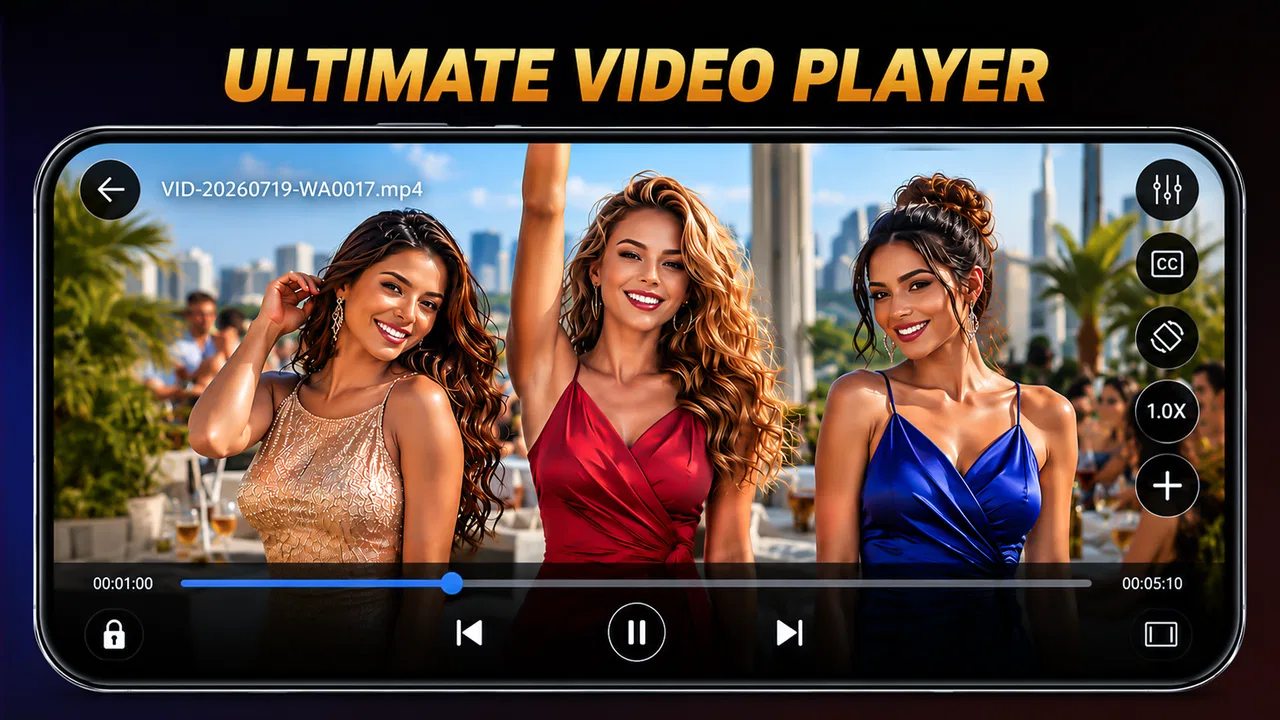
For me, a good player is one that makes the important actions obvious while a video is running. Play, pause, seeking, volume, and returning to the media list should not compete with unnecessary visual clutter. VPlay’s value is strongest when I use it for ordinary playback rather than expecting a full media-center dashboard with elaborate sorting and discovery tools.
There is a useful distinction here between seeing a video and controlling it. A viewer may have no trouble watching a high-definition clip but still struggle to locate a small on-screen control, identify a subtle state change, or drag accurately along a timeline. I recommend testing the player with the device’s own display settings before deciding whether it is comfortable for long sessions. Larger system text or display scaling can help with menus, but it may not enlarge every playback control equally.
I also prefer to begin with a short, familiar clip when setting up any media player. It lets me check whether the controls appear where I expect, whether the screen orientation behaves comfortably, and whether I can exit playback without accidentally opening another item. That small test is more useful than assuming that a player’s support for many formats automatically means its interface will suit every person.
Why the all-in-one approach can help
Combining video and music playback is not just a convenience for people who dislike installing several apps. It can reduce the number of navigation patterns a user has to remember. Someone who relies on a consistent routine may prefer opening one player for a saved lecture, a family recording, or an audio track instead of switching between separate tools.
This is also helpful on a shared device. In my experience, every extra app creates another icon, another settings screen, and another place where a less confident user can get lost. VPlay’s single-purpose identity remains clear even though it handles more than one media type. That makes it a sensible trial for households that need basic playback without building an elaborate collection of applications.
Where navigation may feel less comfortable
The trade-off is that an all-in-one player may not offer the refined organization of an app designed only for music or only for video. If I want carefully managed albums, rich metadata, advanced playlists, or a very visual film library, I would look toward a more specialized alternative. VPlay is better judged as a practical playback tool than as a complete cataloguing system.
People who depend on strong visual separation between sections should also take a few minutes to explore the library rather than relying on the short description alone. The app’s central purpose is clear, but clarity in a store summary does not guarantee that every collection will remain easy to navigate once many files are present. Keeping only current media on the device, or using descriptive file names, can make a noticeable difference.
Motor, sensory, and situational considerations
Here I consider how touch accuracy, viewing comfort, and the surrounding environment can change the experience, even when the same video plays successfully. I find it useful to separate what the player can do from what a user or setting may require. That distinction leads into a practical look at situations where a different device setup or player may be the better fit.
Touch control and precision
Video playback often looks simple until I try to use it one-handed, in a moving vehicle, or with limited finger precision. Tapping pause is usually easier than dragging to an exact moment. Seeking through a long recording may require repeated attempts, and that can be frustrating for anyone with tremors, reduced dexterity, or difficulty maintaining a steady touch.
My practical advice is to use short taps and deliberate pauses rather than trying to perform several actions quickly. When I need to find a particular section in a lecture or demonstration, I prefer making small corrections after the first jump instead of dragging continuously across the timeline. This is not a special feature of VPlay, but it is a workflow that makes a touch-based player less demanding.
A phone stand or stable surface can also improve the experience more than people expect. It removes the need to grip the device while watching and gives the user a better chance of touching controls accurately. For someone with limited hand strength, the difference between holding a phone in the air and resting it on a table can determine whether the app feels usable.
Sound, sight, and mixed media
VPlay’s support for music and high-definition media gives it flexibility, but sensory comfort still depends on the content and the phone. A high-resolution video is not automatically easier to see if text inside the video is tiny, low contrast, or moving quickly. Likewise, clear audio from the file does not guarantee that speech will be easy to follow in a noisy room.
When I watch spoken content, I choose a quiet location and use headphones only when that is comfortable and safe. In a busy home, a speaker can be easier for some listeners; in a public place, headphones may reduce distraction but can make it harder to remain aware of surroundings. The best choice changes with the situation, and the app cannot remove those environmental trade-offs.
Users who are sensitive to bright visuals should be cautious with high-definition clips containing rapid cuts, flashing effects, or intense color changes. That is a property of the video rather than a promise about the player. I would preview unfamiliar material briefly and adjust the phone’s brightness to a comfortable level before settling in for a longer session.
A realistic everyday example
Imagine a parent receiving a family video in a format that the phone’s usual gallery player handles poorly. With VPlay installed, the parent can try opening the file in a dedicated player rather than searching for a conversion tool immediately. If the clip plays, the all-in-one setup keeps the task simple: watch the recording, pause when needed, and return to the media list without learning a new editing workflow.
Now change the situation. The same parent is trying to follow a cooking demonstration while preparing food, with one hand occupied and the phone placed across the room. VPlay may still be useful for playback, but it is not automatically the ideal solution. A larger screen, voice-controlled device operation, or a player with stronger hands-free support could be better. This is an important boundary: format flexibility does not equal hands-free accessibility.
Using it in different environments
VPlay is most comfortable in a controlled setting where I can see the screen, touch it accurately, and hear the content clearly. It is a practical companion for saved recordings during travel, at home, or when checking a file before sharing it. Its usefulness becomes less certain when the phone is outdoors in strong light, being used while walking, or operated by someone who needs unusually large and highly separated controls.
For travel, I recommend testing the actual files before leaving rather than assuming that every video will behave identically. This is one of the app’s most important real-world trade-offs: a player designed around broad media support can be valuable when a file is unusual, but the safest workflow is still to confirm playback in advance. I would also keep the phone charged and avoid treating the app as a substitute for a reliable offline plan.
Compatibility and the role of expectations
The app requires Android 7.0 or later, so device age matters before installation. On a compatible phone, its appeal is the chance to handle different video formats in one place. However, “plays many formats” should not be interpreted as a guarantee that every file will have identical picture quality, sound behavior, or smooth seeking. The source file, the device, and the recording itself all influence the result.
This is where VPlay differs from a typical streaming app. Streaming platforms control their catalog and playback environment, while a general player is useful precisely because I bring my own files. That freedom is valuable for personal recordings and downloaded media, but it also means I am responsible for organizing files and checking whether a particular clip behaves as expected.
Costs and the free starting point
The app can be installed for free, which makes trying it low-risk for someone who needs a straightforward player. There are in-app purchases ranging from $0.99 to $24.99 per item. I would pay attention to the purchase prompts during normal use and decide whether the free experience already covers my needs before spending anything.
For a user who only wants occasional playback, the free entry point is a strong reason to test VPlay. For someone seeking a completely distraction-free experience or a more specialized media workflow, the presence of optional purchases may be a reason to compare it with another player first. I would not buy anything simply to solve a navigation problem without first checking the phone’s display and control settings.
How it compares with usual alternatives
Compared with the default gallery player, VPlay is more attractive when the built-in option struggles with a particular file or separates audio and video into different places. Its all-in-one design can shorten the path from finding a file to playing it. That is the clearest practical advantage I see.
Compared with a feature-heavy media player, VPlay may feel less specialized. Advanced users who want precise library management, extensive playback customization, or a carefully structured home media system may prefer a different tool. I would also choose a streaming service when the main goal is discovering licensed online content rather than opening files already stored on the phone.
For accessibility-focused use, I would compare it with a player whose controls and navigation are explicitly designed around the user’s particular needs. VPlay’s Everyone age rating makes it approachable, but an age rating is not the same thing as an accessibility guarantee. A person who depends on screen-reader compatibility, unusually large controls, or reliable hands-free operation should test those exact requirements rather than infer them from the app’s general simplicity.
Remaining barriers worth considering
The biggest barrier is the gap between broad format support and a fully inclusive viewing experience. A file may open, yet the user can still face small controls, difficult timeline movement, distracting media lists, or audio that is hard to separate from background noise. These issues are easy to overlook when the only question is whether playback begins.
Another barrier is the lack of a single best setup for everyone. One user may value a compact player and minimal steps, while another needs stronger organization and more control over how content is presented. VPlay’s design makes sense for the first group, but the second group may spend more time adapting their library and device than they would with a specialized alternative.
I also would not recommend it as the first choice for someone who needs a tool for editing rather than watching. Although it belongs to the video players and editors category, my assessment centers on its playback role. If the task is trimming footage, adding captions, creating a presentation, or producing a finished video, a dedicated editor is likely to be a better match.
Who should try it first
I would recommend VPlay to people who regularly open locally stored videos, want music playback in the same app, or have encountered files that do not behave well in a phone’s default player. It is also worth trying on a shared family device where a simple, free starting point is more important than a deep collection of advanced tools.
I would be more cautious about recommending it to users who need highly structured libraries, precise accessibility behavior, or hands-free control. Those needs are specific enough that the app should be tested with the person’s actual device, files, and daily routine. A smooth experience for casual viewing does not prove that it will work for a user with demanding motor or sensory requirements.
My inclusive verdict
VPlay succeeds when I treat it as a practical bridge between a phone’s stored media and the act of watching or listening. Its free availability, broad playback purpose, Everyone rating, and single-app approach make it approachable. The app has also reached more than five million installs and holds an average rating of 3.6 from around eleven thousand ratings, which suggests that it has found a substantial audience while leaving room for mixed experiences.
My recommendation is therefore conditional but positive: try it if your main problem is straightforward playback across different video formats, especially when the default player feels limiting. Before relying on it for an important trip, a shared device, or a user with specific accessibility needs, test a few real files and the controls that matter most. That brief check reveals more than the headline promise.
VPlay is not the universal answer to every media or access challenge, and I would not present it as one. Its best quality is practical flexibility, not deep specialization. For casual viewers, families, and people who want video and music in one place, that can be enough. For everyone else, particularly users who need carefully engineered navigation or hands-free operation, comparing it with a more focused alternative is the wiser final step.
FAQs for VPlay: All in One Video Player
01What is VPlay: All in One Video Player?
VPlay: All in One Video Player is designed as a versatile media player for watching videos in different formats from one convenient app. It may let you play locally stored files, organize your personal video library, and use common playback controls such as subtitles, volume adjustment, screen orientation, and seeking. The exact features can vary depending on the version, device, and operating system.
02Which video formats does VPlay support?
VPlay is intended to handle a broad selection of popular video and audio formats, making it useful when your files come from different sources. However, compatibility is not identical on every Android or iOS device because playback can depend on the operating system, available codecs, file encoding, and hardware performance. Checking the app listing and testing a sample file is recommended before moving your entire library.
03Can I use VPlay to watch videos offline?
If the video files are already saved on your device and supported by the application, VPlay can generally be used without an internet connection for local playback. This makes it suitable for travel or areas with unreliable connectivity. Internet access may still be required for downloading files, accessing online content, displaying advertisements, or using any cloud-related feature included in the installed version.
04Does VPlay support subtitles and background playback?
VPlay may include practical viewing features such as subtitle support, playback speed controls, repeat options, and background or floating playback, depending on the platform and current release. Subtitle behavior can vary by file type and subtitle format, while background playback may be limited by device settings or app policies. Review the permissions and feature notes before downloading.
05Is VPlay: All in One Video Player free to download and safe to use?
The application may be available as a free download, although some versions can include advertising, optional purchases, or premium features. As with any media player, download it only from an official app store or a trusted source, and review the requested permissions carefully. Pay particular attention to access involving storage, photos, media files, network connections, or other personal information.
Pros
- Supports many popular video formats without extra conversions.
- Simple interface makes playback easy for beginners.
- Includes subtitle support for multilingual viewing.
- Offers convenient playback controls and seeking options.
- Can reduce the need for several separate media player apps.
Cons
- Performance may vary depending on device hardware and video resolution.
- Some advanced playback features may require in-app purchases.
- The app may display advertisements during use.
- Subtitle formatting and synchronization may not work perfectly with every file.
- Privacy permissions should be reviewed before granting access to local media.

VPlay: All in One Video Player
Gallery